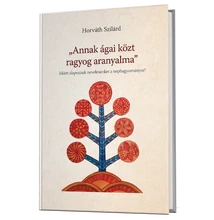

Horváth Szilárd: "A golden apple shining through" Why do we base our education on folk tradition?
Ár:
4.150 Ft
| Szerző: | Horváth Szilárd |
| Kiadás éve: | 2025 |
Why do we base our education on folk tradition? |
|
| Kiadó: | Magyar Kultúra Kiadó Kft. |
| Katalógusszám: | MKK134 |
| ISBN: | 978 615 5746 56 7 |
| Elérhetőség: | Raktáron |
| Szállítási díj: | 1.269 Ft |
| Várható szállítás: | 2026. november 30. |
|
|
|
Leírás
Preface
Honoring the ancestors is the foundation of all knowledge. The culture of humanity is passed on from generation to generation, building on each other. In the gospels we read that a house built without foundation will collapse.
Our ancestors left us many thousands of years of organic culture, one that stood the test of time and led us through many trials into the 21st century.
I am writing a preface – that is to say, a living word, because it is worthy of the book presenting an organic culture that the readers can hold in their hands. Szilárd Horváth not only writes down, but also practices and teaches what he knows, making it come alive in the souls of families and children.
He does all this in an exemplary way, in accordance with our Christian values, and also in connection with organic Hungarian knowledge – the many thousands of years of our people’s world of traditions.
This must be emphasized because, unfortunately, there are many who don’t know what to do with folk culture. This is an absurd situation, not unlike a family where the children are unable to connect with the values of their parents and grandparents.
I am sure that if we raised and educated people from a young age with this spirit and value system, then no one would leave home to work in the West, because they would be proud of the ancestors’ world of tradition and never abandon it for money. They would dearly love the homeland, the nation that put such a treasure up their sleeves. And this would allow for a backbone that not even the gates of hell could prevail against.
I am convinced that if we do not create this harmony, we cannot raise children in a way that is pleasing to God, and further in failing to do so we raise a generation without roots. The Hungarian world of tradition is about love, about recognizing the light of God within us, but extended into a community space, emphasizing the community dimension.
We have already recognized that it is now enough to refine the mind, but the heart, the spiritual intelligence as it relates to community and soul must also undergo a similar development for the whole individual to grow up wholesomely.
Molnár V. József writes in one of his books that God recreates the world with each person. That is true, but education has to help young people realize the divine program ingrained in their souls and provide the right conditions for this to take place.
A child’s drawing indicates this image–sign–image order for the parents and the educators, and education must be done in accordance with this.
Our folk songs, illustrative art, folk tales, and the order of the year’s cycle precisely mark the way we must follow to the end.
Acquiring knowledge about life is a fundamental task. I enjoy visiting Transylvania also because this knowledge is still alive there, though challenged by the Western consumer lifestyle and attitudes. I always return home much richer than when I left.
I wish from the bottom of my heart that this book will fulfill its mission and show us the way and that we will strive to make what we learn come to life.
Szabó Gyula, Priest
President of the Magyar Műhely Közhasznú Alapítvány
Introduction
„The past is not behind, but within us.”
Csoóri Sándor
To our ancestors, to whom we owe our present knowledge:
Bálint Sándor, Molnár V. József, Pécsi Rita,
along with the instructors, the community of parents,
and students of the Búzaszem School,
who shape the Hungary of the future.
Christianity, Hungarian folk tradition and nature are the most important factors in the healthy growth of our children at school. This book is about the advantages of using Hungarian folk tradition as an educational force.
Over several millennia, our forefathers created the treasures that have been gathered by several researchers over the last two centuries. Our collection of folk tales, folk games, folk music, folk song, folk tradition, and folk handicrafts are uniquely rich. In other words, we have the treasures of our forefathers in our hands. This treasure conveys the Hungarian mindset and sign system through several channels, and helps those who receive it from a young age to discover, understand and improve themselves and the world in many ways.
A host of educational researchers have already discovered what art – which naturally includes folk art – can do for people. A child who spends at least an hour playing music or singing will perform twenty percent better within a few years in mathematic thought and reading comprehension, along with social skills and emotional intelligence than his or her peers raised without music and singing. A host of educational researchers also reported that art was a remedy for personality problems and learning difficulties. Hungarian folk tradition – which encompasses complex activities, such as folk games, folk tales, folk music, folk song, folk dance, folk handicrafts and folk religion as well – is art, and thus can provide at least as much as other artistic activities for reading comprehension, mathematics, emotional intelligence, and social skills. But Hungarian folk tradition can do something else as well – provide a Hungarian identity. Kodály Zoltán called this sense of belonging, developed with the help of folk tradition, a ‘subconscious Hungarianness.’
With education based on Hungarian folk tradition, we can raise complete personalities; smart, moral, cooperative young adults with a high emotional and intellectual intelligence, who will become the leaven of their respective future family, church and nation. They will be better than us.
Despite this, Hungarian folk tradition is used as an educational force in only a few schools in Hungary today.
With my writing, I would like to encourage those parents and educators, who enjoy Hungarian folk tradition, and would be happy to base the education of their own children or the children they are entrusted with on it, but doubt that the values handed down by folk tradition could be valid in the 21st century.
Not only are they valid, but they can provide the most: the solution to school problems and difficulties, minor and major personality problems, and a healthy, Hungarian, Christian, male or female self-identity.
Therefore, be brave and resolute. Education based on Hungarian folk tradition is – in addition to what we already said about it – a token of diversity in the world, but only if all people do the same, that is, preserve and pass down their own culture.
Graphics: Mészáros Erika Szilárda
Editor: Takács Zsolt
Published by Magyar Kultúra Kiadó Kft.
Publisher in charge: Takács Szilvia
Typesetting, cover design: Kollár Gábor János
Printing: Táltos Nyomda, Győr
www.mkkiado.hu
ISBN 978 615 5746 56 7
Paraméterek
| Borító | Keménytáblás |
| Oldalszám | 152 |
| Nyelv | magyar |